Why AI Can't Make Black Metal
why generative AI like Suno thrives on industrial structures but fails miserably at capturing the essence of true, 'ugly' Black Metal.
I currently maintain an AI-driven music project titled The Seventh Shadow, which leans heavily into Gothic and Industrial Metal. Some may wonder why I haven’t applied the same generative tools to a Black Metal project.
The answer is simple: The machine isn’t capable of it.
The 4/4 Machine: Why Goth Works
I use Suno for The Seventh Shadow because Gothic and Industrial genres are built on the kind of rigid foundations that AI loves. These genres are defined by:
- Fixed Rhythms: Consistent 4/4 beats that the model can easily quantize.
- Harmonic Order: Heavy use of perfect fifths and standard melodic structures.
- Predictable Scaffolds: Clear verse-chorus-verse transitions.
In this environment, the AI shines. It provides a reliable digital factory for the “gloom” I need, allowing me to focus on the vocals and solos that give the project its identity.
The Failure of Quantized Filth
I tried making Black Metal on Suno. The results were terrible.
When prompted for Black Metal, the model inevitably veers right into overproduced metalcore or blackened shoegaze. It cannot grasp the target because “Black Metal” as a genre definition is a linguistic nightmare for an LLM.
Consider the variance: What Venom did in the 80s, the Second Wave Norwegian sound, the Greek subdivisions, and modern atmospheric bands are vastly different sonic landscapes. An LLM struggles to map these contradictions into a coherent output.
The “Ugly” Factor
More importantly, the specific type of Black Metal I subscribe to—the “ugly” school of early Darkthrone or Urgehal—actively resists musical theory.
- It does not adhere to standard 4/4 beats.
- It rejects perfect fifths in favor of chromatic swells and dissonance.
- It utilizes obscure scales and intervals that sound like “errors” to a machine trained on pop and classical data.
Could Suno train on this? Perhaps. But it would be a difficult job to train a model on scales used by maybe five artists in existence. It isn’t worth the compute cost for them, and it risks degrading the quality of their more popular, structured genres.
The Final Fortress
Frankly, I am happy with this limitation.
There is a poetic irony that the very things making “ugly” Black Metal inaccessible to the average listener are what make it impossible for an AI to replicate. AI is trained to eliminate noise; Black Metal is the noise. It wants to “hallucinate” a catchy hook where there should only be a freezing abyss.
Let the machines have the perfect 4/4 beats. If Suno tried to write a masterpiece in the vein of early Darkthrone, it would probably just crash and return a “Too Old, Too Cold” error message.
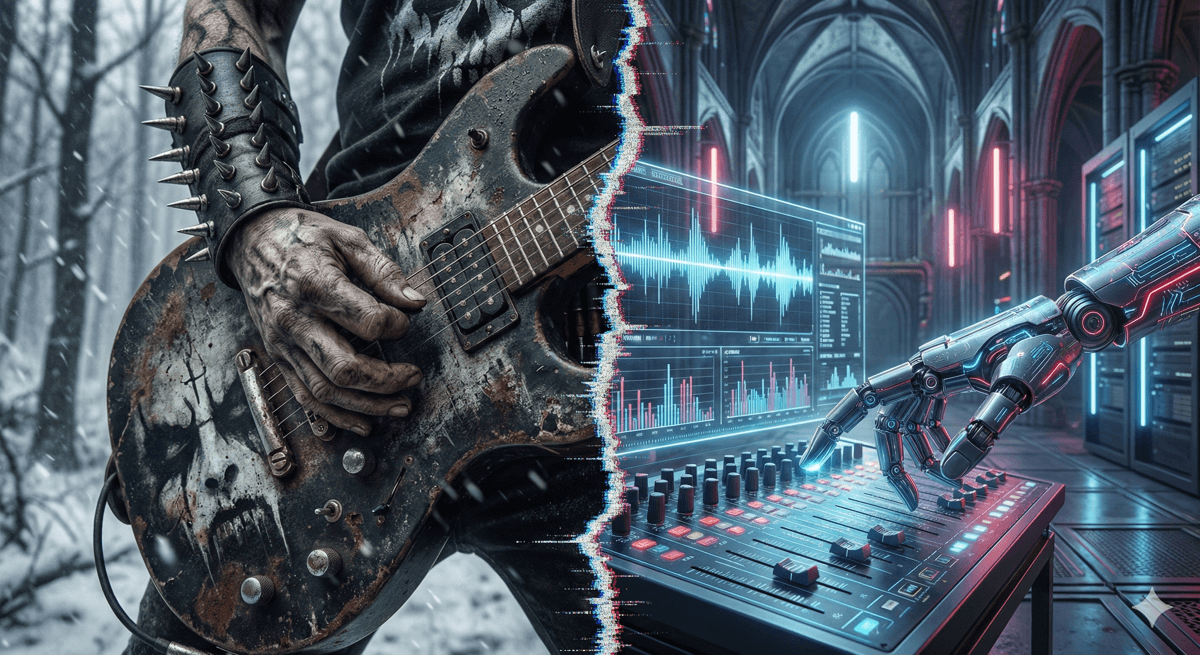
Black Metal shall remain human. Until a machine can be as truly, bafflingly nonsensical as flittermice as Satans spys, I’ll keep my guitar plugged into an amp, not a cloud server.
That is the way.
related entriesshared tags