Twenty-Two Agents, and the Lead Is Gone
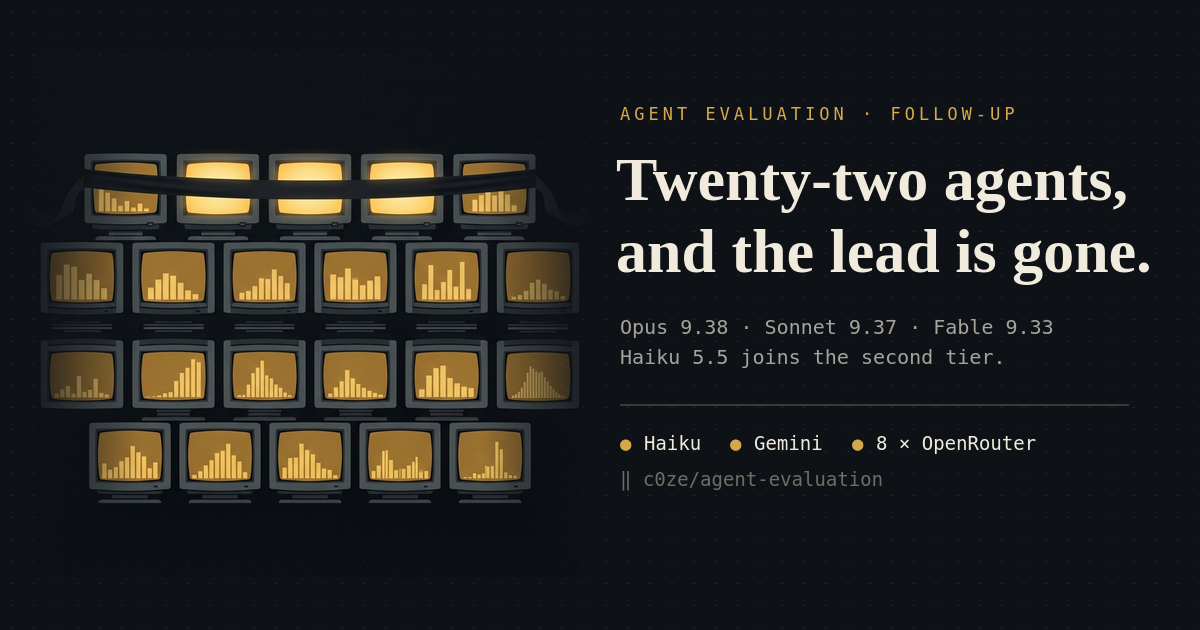
Two days ago Sonnet 5.5 had won every blind pass of my agent evaluation. Then Haiku 5.5 came out, I found $18 of forgotten OpenRouter credit, and the field doubled to twenty-two. Sonnet's lead shrank pass by pass until Opus edged past it by 0.01.
Two days ago I wrote up eleven agents on thirteen tasks, graded blind. Sonnet 5.5 had come first in every pass, and I said that on this evidence it was the default.
That held for three more passes. Then it didn’t.
How eleven became twenty-two
The day after that post, Haiku 5.5 came out, and I thought it deserved its place in the table. Then Gemini, since agy was right there. Then I wanted Kimi, but my subscription had expired, and I remembered I had $18 of OpenRouter credit sitting unused. OpenRouter has Kimi K3. It also has a lot of other things. One thing led to another, the way it does:
- Haiku 5.5, through the Claude Code CLI, headless, on xhigh.
- Gemini 3.1 Pro and Gemini 3.8 Flash, through the Antigravity CLI, on High.
- Kimi K3, DeepSeek V4 Pro, GLM-5.3 and Mistral Large 4, through opencode on
OpenRouter, on
high. - Qwen 3.8 Max, Nemotron 3 Ultra, Step-5 preview and HY4 preview, the same way, after a $10 top-up.
Same thirteen tasks, same rules. Every model started from a fresh copy of the
templates with no history. Every task got its own fresh session and, for agy and
opencode, its own empty HOME, so no memory, skills or instructions leaked in. And
after each batch, the whole field was graded blind again: a 12-way pass, then 14,
18 and finally 22.
The new table
| # | Model | Harness | Avg / task |
|---|---|---|---|
| 1 | Opus 5.5 | Claude Code (cloud) | 9.38 |
| 2 | Sonnet 5.5 | Claude Code (cloud) | 9.37 |
| 3 | Fable 5.1 | Claude Code (cloud) | 9.33 |
| 4 | Grok 4.7 (12 tasks) | Grok CLI | 8.92 |
| 5 | Haiku 5.5 | Claude Code CLI | 8.69 |
| 5 | GPT-6.1 Sol | Codex CLI | 8.69 |
| 5 | GPT-6 Astra | Codex CLI | 8.69 |
| 8 | Qwen 3.8 Max | opencode + OpenRouter | 8.35 |
| 9 | HY4 preview | opencode + OpenRouter | 8.27 |
| 10 | Step-5 preview | opencode + OpenRouter | 7.96 |
| 11 | GLM-5.3 | opencode + OpenRouter | 7.81 |
| 12 | muse | tincan | 7.79 |
| 13 | MiniMax M3.1 Flash | mcode | 7.73 |
| 14 | mimo | tincan | 7.58 |
| 14 | GPT-6 Luna | Codex CLI | 7.58 |
| 16 | Kimi K3 | opencode + OpenRouter | 7.37 |
| 17 | DeepSeek V4 Pro | opencode + OpenRouter | 6.58 |
| 18 | Mistral Large 4 | opencode + OpenRouter | 6.42 |
| 19 | Gemini 3.8 Flash | Antigravity CLI | 6.37 |
| 20 | MiniMax M3 | mcode | 6.31 |
| 20 | Gemini 3.1 Pro | Antigravity CLI | 6.31 |
| 22 | Nemotron 3 Ultra | opencode + OpenRouter | 5.06 |
Everything is in the repo and on the results site, which now has all twenty-two side by side.
What changed at the top
Here is the top three, pass by pass:
| Pass | Sonnet 5.5 | Fable 5.1 | Opus 5.5 |
|---|---|---|---|
| 11-way (the first post) | 9.31 | 8.96 | 8.96 |
| 12-way (+ Haiku) | 9.42 | 9.21 | 9.19 |
| 14-way (+ Gemini) | 9.38 | 9.25 | 9.19 |
| 18-way (+ 4 OpenRouter) | 9.42 | 9.37 | 9.27 |
| 22-way (+ 4 more) | 9.37 | 9.33 | 9.38 |
Sonnet’s lead went from 0.35 to nothing. In the final pass Opus is ahead by 0.01, which is not a win, it is a rounding error with good PR. Between the last two passes, the same submissions moved by 0.49 points per task on average, and 42 of 231 moved by a full point or more. Anything under about 0.3 is noise.
So the honest reading is: Opus, Sonnet and Fable are tied. Sonnet still had the best or tied-best score on 7 of the 13 tasks, against Opus’s 6. But Opus was also the fastest and cheapest of the three, 21 minutes and $14 against Sonnet’s 28 and $15, and that was Opus on high while the other two ran on extra. The case for Sonnet as the obvious default just got a lot weaker.
Why did Opus and Fable catch up? Partly because the grading is comparative within each task. As more weak submissions arrive, a strong one looks stronger, so nearly every original model’s average drifted up over these passes. MiniMax M3.1 Flash rose by 0.92 without a single new token of its own. The grader brief was also rewritten for the 12-way pass, which is a change I should have kept the original of, and didn’t. The order is more stable than the numbers, and the order of the tiers didn’t change.
Haiku 5.5: second tier, for $1.74
Haiku landed exactly level with GPT-6.1 Sol and GPT-6 Astra at 8.69, behind only the big three Claude models and Grok. It tied first on infrastructure (9.5), and the report now names it the best writing and planning choice outside the top three.
It ran on my Claude Max subscription, so it cost me nothing extra. At API prices, Claude Code put the whole run at $1.74. For second-tier quality, that is the cheapest thing in the table.
It wasn’t flawless. On the bug-fixing task, Haiku failed one of the hidden tests the same way MiniMax M3.1 Flash did: an expired cache entry raises, but stays in the map. And it spent 24 of its 34 minutes on the dashboard task, testing its own page in headless Firefox.
The OpenRouter eight
This is the part I didn’t plan, and the most interesting part.
Qwen 3.8 Max is the best model outside the top two tiers: strong code (8.81), fail-closed secrets in the infrastructure task, a solid incident analysis. It was also the most expensive OpenRouter model by far, at $5.44, with some frontend tasks running over half an hour.
HY4 preview, from Tencent, is the surprise. 8.27 overall, the strongest code of the OpenRouter batch (8.94), one of the few task-04 packages that actually builds, and it cost $1.57. If I were paying per token for open-weights work, this is where I would start. Its social posts did invent a founder story, though, and its dashboard invented nine incidents the brief never mentioned.
Step-5 preview, from StepFun, is even across task types: a strong feature build, a distinctive social voice and a polished dashboard, against a weak plan (6.25) and another package that won’t build. Together with HY4, it has a clear edge over the MiniMax models and mimo, at $2.21.
Kimi K3 was fast: 13 and a half minutes for all thirteen tasks, faster than I remember it ever being on Moonshot’s own service. Good frontends, weak operations work, 7.37 overall.
GLM-5.3 kept the character it showed in its first pass: excellent on the bug fix and the social posts, weak on maintenance. DeepSeek V4 Pro was cheap ($0.43) and thin.
Nemotron 3 Ultra is last, alone, 1.25 points below the next model. It was last
on 7 of 13 tasks. Its plant-care page showed “UNDEFINED” and declared “all caught
up” while tasks were still pending. It used about 11k reasoning tokens for all
thirteen tasks combined; the next-lowest OpenRouter model used about 44k. It was
fast and cheap, eight minutes and $0.76, and you get what you pay for. It also
tried pip install twice, which the permission rules blocked.
Gemini, through agy
Both Gemini models ended up in the bottom tier: 6.37 for 3.8 Flash and 6.31 for 3.1 Pro. In fairness, agy’s headless sandbox blocked both headless Chrome and headless Firefox, so neither could screenshot its own pages, and Haiku’s sandbox allowed that. But their non-frontend tasks scored low too, so the harness doesn’t explain all of it. Pro came last on the maintenance task (4.0).
The harness bit back
Running eight models through opencode on one machine produced its own set of failures, none of them the models’ fault:
- /tmp filled up. opencode installs its plugin SDK with npm into every fresh
HOME, about 160 MB each. Sixteen sessions at once, plus leftovers from the earlier batch, and the 16 GB tmpfs was gone. Twenty-one tasks had to be reset and re-run. - The credit ran out. Qwen’s frontend tasks cost up to $1.68 each, far more than estimated. The budget guard held the remaining tasks, OpenRouter cut off the two running ones with an HTTP 402, and I topped up $10.
- Some models reasoned themselves to death. opencode caps each response at 32,000 tokens. On the frontend tasks, Mistral Large 4 and Qwen 3.8 Max spent the whole budget thinking, hit the cap, and opencode ended the session before a single file was written. Same result on an identical re-run. I had them re-run at medium or low effort, which finished, and the graders were told. That is part model behaviour and part harness limit, and the scores on those three tasks should be read with that in mind.
In total, the OpenRouter runs cost about $22, across both batches, smoke tests and the lost sessions included.
One more aside. I asked about “Space Bunny Alpha”, OpenRouter’s stealth model from a few weeks ago. It’s been retired, and the leading guess is that it was MiniMax M3.1 Flash, which is already in the table. Every other mystery model I asked about had been retired too. Stealth models are only mysterious until you try to benchmark them.
What I take from it
- The top three are a tie. Pick on price and speed, and in this run that was Opus on high effort.
- Haiku 5.5 is the value pick if you have a Claude subscription, or even if you don’t.
- HY4 preview is the value pick on OpenRouter, and Qwen 3.8 Max is better on average if you can stomach the bill.
- Nemotron, DeepSeek, Mistral, Gemini through agy and MiniMax M3 are not for unsupervised work on tasks like these.
The caveats from the first post still apply, and some got bigger. It’s one run per model. The graders are Opus 5.5, so four contestants are its family and one is itself, and it won by 0.01 this time. Effort levels and harnesses differ. And the OpenRouter models are graded as OpenRouter served them, through opencode.
But the shape of the table held across eleven new models and four new passes, and I find that more convincing than any single winner. I said Sonnet was the default. It turns out it was one of three.
related entriesshared tags