812 Programs From a 1980s Turkish Magazine, and 682 of Them Run
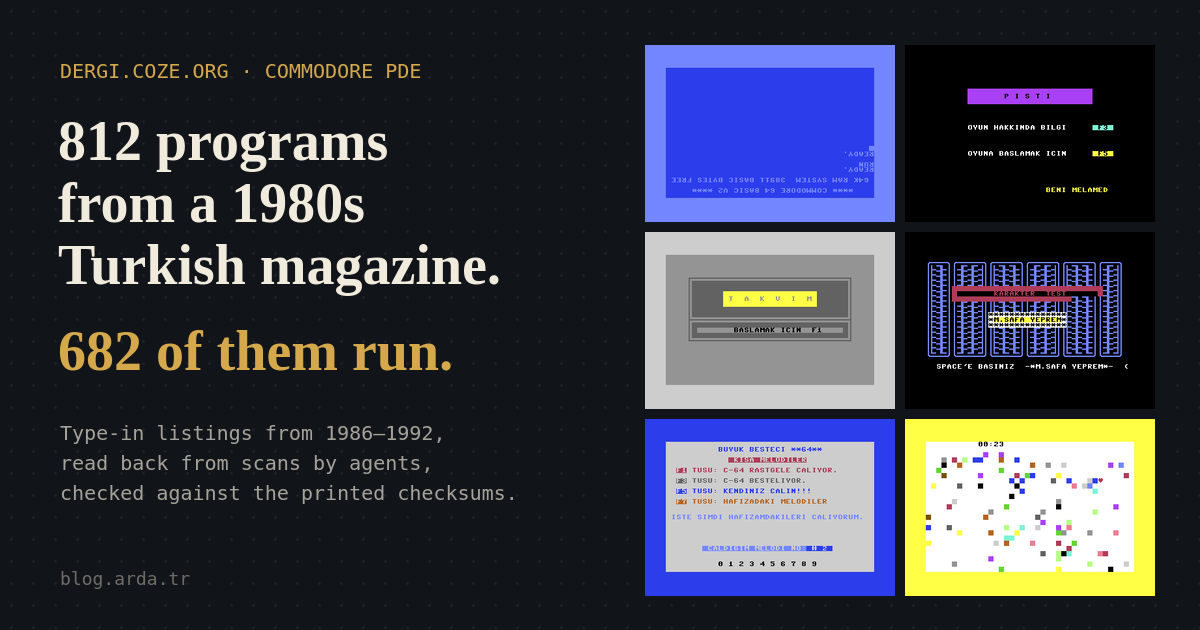
dergi.coze.org now has the type-in listings from Commodore's Program Döküm Eki, issues 1–78, as .prg files you can run in the browser. Agents read them back from the scans and checked every line against the checksums the magazine printed for its readers. 682 of 812 programs work. This is how, and why the other 130 don't.
From March 1986, a C64 owner in Turkey who bought Commodore magazine got a supplement with it, the Program Döküm Eki (program listing supplement). It was pages of type-in programs: BASIC listings and rows of machine code in hex, each line ending in a small checksum. You sat down, typed for an evening, and if every checksum matched, you had a new program.
dergi.coze.org, my archive of Turkish retro computer magazines
(the first post about it is in Turkish), now has all 78
of those supplements, from March 1986 to 1992. Agents read the listings back from the scans,
checked them line by line against the same checksums, built them into .prg files and ran
them in an emulator. 812 programs came out of the listings, and 682 of them run. Every
one of them is on its issue’s page, and the ones that stand alone start in a C64 in your
browser.
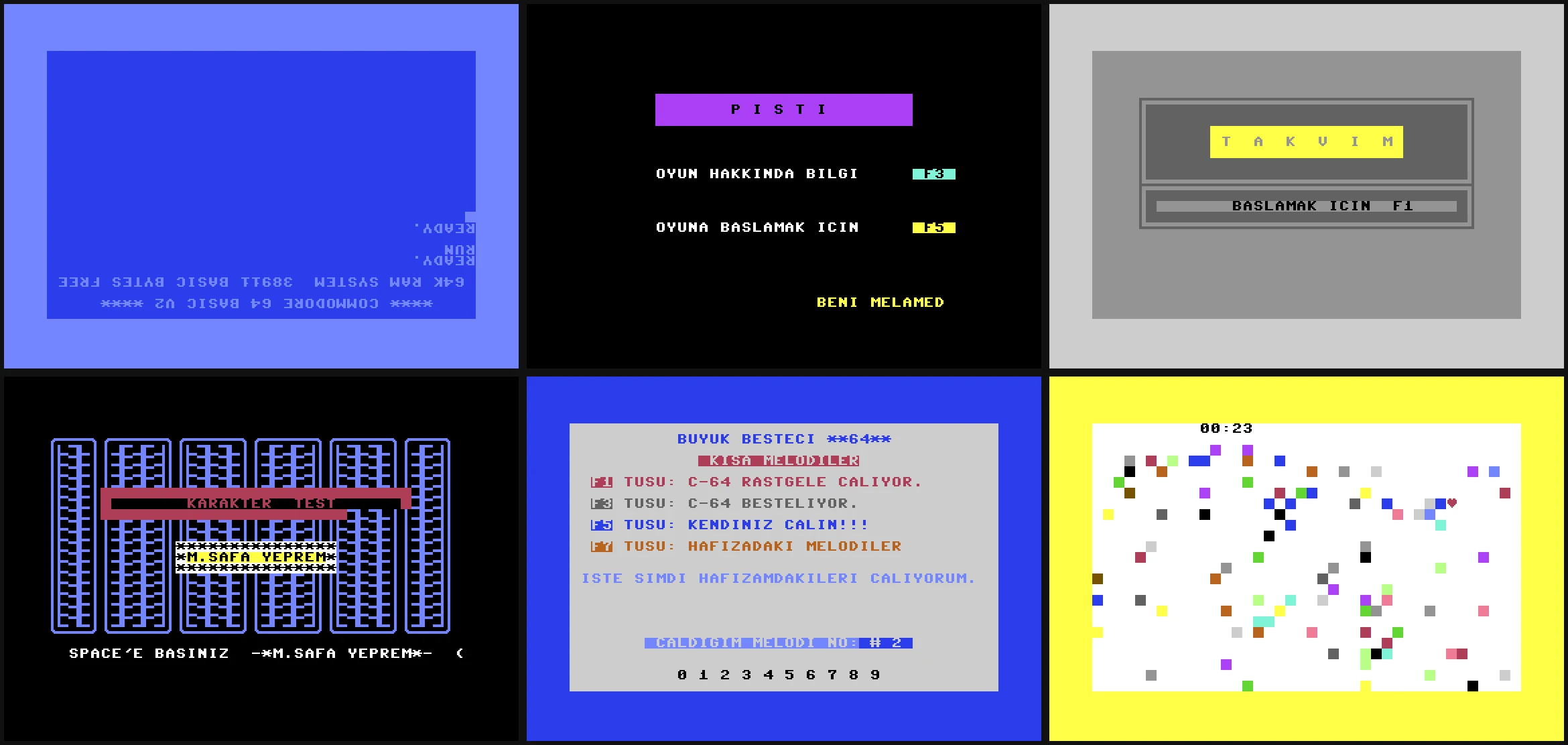
The checksums were for the readers
The supplement printed two kinds of listing, each for one of the magazine’s own typing
programs. Machine code was for the MDE (Makine Dili Editörü): an address, eight bytes and
a checksum byte, like 0841 : A5 02 91 F7 98 49 07 A8 8C. BASIC was for the BDE (BASIC
Dili Editörü): a five-digit line number, the line, and its checksum in angle brackets, like
00570 IF PEEK(211)>12 THEN ... <139>. With a checksum on every line, a typo showed up on
the line where you made it, not after an hour of typing.
That’s what made this project possible. An OCR’d listing is usually a dead end, because one wrong character breaks a program and you can’t tell which. These listings carry their own proof. A line that matches its printed checksum was almost certainly read right; a line that doesn’t tells you exactly where to look.
Reading it back
The pipeline does what the reader did, with agents doing the typing:
- Each listing page is cut into crops, column by column. Claude Haiku reads the crops, and the lines that fail their checksum are read again by Claude Sonnet.
- The readings are merged, and every line is checked against its printed checksum. Every
GOTO,GOSUBandTHENtarget has to be a line that actually exists in the listing. - The lines become a
.prg(BASIC tokenized, machine code at its printed addresses), and the program is run headless in VICE: x64sc for the C64, x128 for the C128’s BASIC 7.0 programs, and a Simons’ BASIC cartridge for the Simons’ BASIC ones. The screen afterRUNis captured and read back. - Programs that work and stand alone get a button on the site that starts them in EmulatorJS’s VICE, in the browser. The Simons’ BASIC ones need your own cartridge file, which stays in your browser.
The first pass went on the site in batches between November 3 and 4: 206 of 227 programs in issues 1–20, 81 of 101 in 31–40, 271 of 350 in 41–78. That made 686 working programs.
Then the count went down
686 was the wrong number. A checksum is one byte, so a random wrong line passes about one time in 256, and a correction step that tries many fixes will find that one time. An audit on November 5 went through six programs in detail and found the correction step making wrong lines pass in two ways: machine-code rows with two byte errors that cancelled out in the checksum, and fixes that “corrected” the printed checksum itself to fit the line.
So the merge got stricter. A re-read is accepted only if its checksum is a plausible misreading of the first reading’s (a 3 for an 8, a B for a D), never a rewrite of it. The rows and lines it now refused were read again from 300-dpi renders of the PDF, and kept only where two readers agreed. The count went down to 611 of 812. That was the honest number.
Near misses
99 of the failing programs failed on only one to three lines. Those got a pass of their own, one agent per issue, with a written brief. The rules were strict: render the failing line from the PDF at 600 dpi (up to 3000 for the worst), read it character by character before looking at the old reading, and accept a change only if the image supports it. The print’s own look-alikes (0/8/B/D, 3/8/9, 5/6/S, 1/7/I, E/F, colon and semicolon) were allowed; a clearly printed checksum or byte was never touched.
Here is one, from TERS EKRAN (“upside-down screen”) in issue 3, May 1986:

Row 0849 reads C8 D0 E6 E6 F8 A5 F2 C3 44, and no single change makes that pass. At 600
dpi, the “2” in F2 has a closed lower bowl and a gap in its upper stroke: it’s an 8 with a
broken line. And this printer’s 9 looks like a 3: one row up, the 49 in row 0841 looks
like 43, and only 49 passes there. Read as F8 C9, the row passes its checksum.
The code agrees: C3 is an illegal opcode, while C9 is CMP, and the row becomes
INY / BNE / INC $F8 / LDA $F8 / CMP #$E0, a loop over the character ROM’s pages. The
program reads the character ROM to build an upside-down character set, which is the first
screen in the grid above.
Disassembly was allowed to break a tie only when the image already allowed both readings. A fix chosen only because the code “makes more sense” doesn’t count. Five lines like that are waiting for me to decide.
The pass fixed 70 of the 99 programs, and none that worked before broke. That took the count from 611 to 681. One more changed when a listing turned out to be part of a larger program, and the site says 682 as of today.
The magazine’s own mistakes
Some lines will never pass, because the magazine printed them wrong. A line that is clearly
printed but fails its checksum, or a GOTO to a line that the magazine never printed (the
numbers before and after it are on the page, with nothing between), is kept exactly as
printed and noted on the program’s page as a misprint. It only counts as working if the
program then runs in VICE without an error.
The supplements have a few habits that the pipeline now knows about:
- Some issues’ printers dropped every quote mark and every graphics character inside quotes.
The quotes are put back where the image shows the gap and the checksum agrees. Box-drawing
graphics that were dropped are restored in the
.prgfrom the checksum, while the listing on the site stays as printed. - C128 listings print some BASIC 7.0 keywords 76 places too low in the token table.
- Corrections printed in a later issue are applied as errata.
- Machine-code rows that were never printed are filled with zeros, so the code after them stays at its printed address.
Some bugs are the authors’. MONITOR in issue 11 runs, and the magazine’s version has a
bug at $C517. That’s the program as printed, so that’s the program on the site.
Since then, the same pipeline has started on 64’ler, another C64 magazine of the time,
which writes its listings differently: colours spelled out by name, several control codes
in one bracket, (CLR) in parentheses, and GOTO targets printed with a leading zero.
There, misprints that a single character fixes are corrected in the .prg by their
checksums, and the program page says so.
The 130 that don’t run
130 programs still don’t work, and each one says why on its page, under “Sorun bulundu” (problem found). They are still downloadable. Many have more than one problem, so the rows add up to more than 130:
| What fails | Programs |
|---|---|
| Lines that fail their checksum | 119 |
| VICE stops with an error | 35 |
| A character no one could read | 20 |
| A jump to a line that isn’t in the listing | 18 |
| Machine-code rows missing | 12 |
The causes are mostly the scans: faint print, low-resolution copies, and pages where graphics inside strings blurred into shapes that no checksum can settle. Some are the printing itself. The worst run of issues is 51–60, where 58 of 97 programs work. Issues 1–10 and 71–78 are at 94% and 95%. A few failures are big: ANIMAL MATCH in issue 38 fails on dozens of machine-code rows, and an English dictionary program in the same issue fails on most of its BASIC lines.
These could go up. A cleaner scan of a bad issue would fix more than another reading pass. If you still have the paper supplements, I’d like to hear from you.
Programming archaeology
What I like about this is that the agents had to do the reader’s job. In 1986, someone sat
with the supplement open next to the keyboard, typed 0849 : C8 D0 E6..., and found out
from the checksum when they got a digit wrong. Forty years later, the scan is the only copy
left, the print is smeared, and the checksum is still the thing that decides whether a line
is right. 412 of the programs have every single line verified that way. The other 270 that run
have at least one line the checksums can’t vouch for, like a misprint.
Go to Program Döküm Eki, pick an issue, and press the button. TERS EKRAN is here.
related entriesshared tags