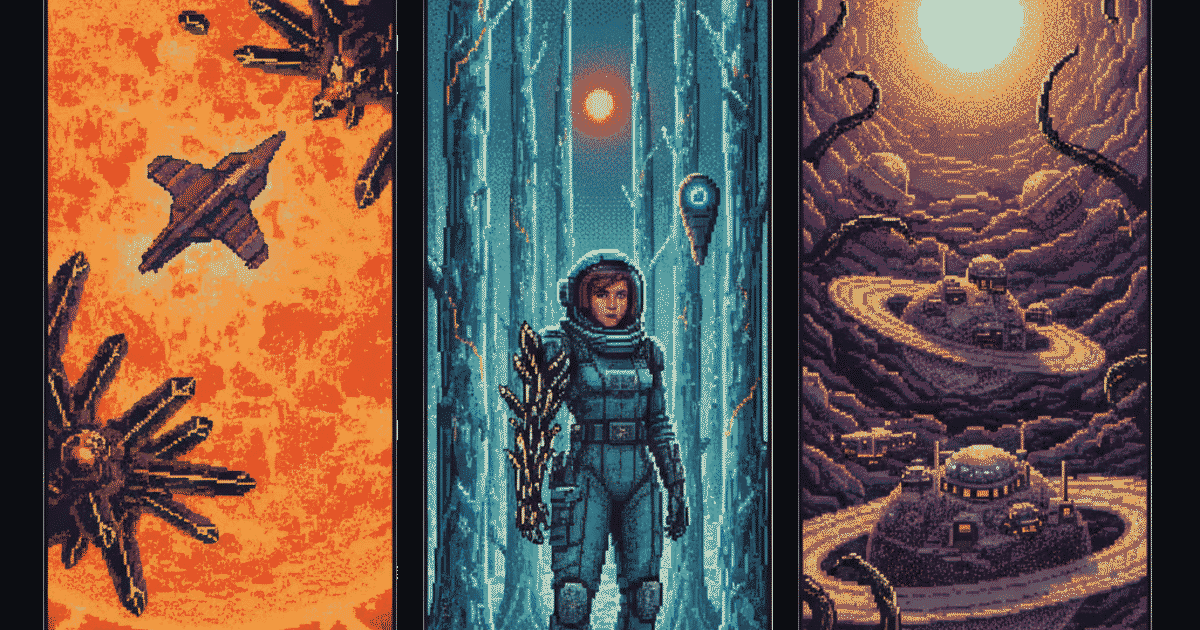
Mass Fraction: a love letter to Deuteros, in sixteen colours
Mass Fraction is out on itch.io: hard science fiction space-industry strategy at 640×512 in sixteen colours, and my love letter to Deuteros and Millennium 2.2. Build a space program under a shell of debris, train people who can die, and stay off the registry of machines that remove anything unregistered.
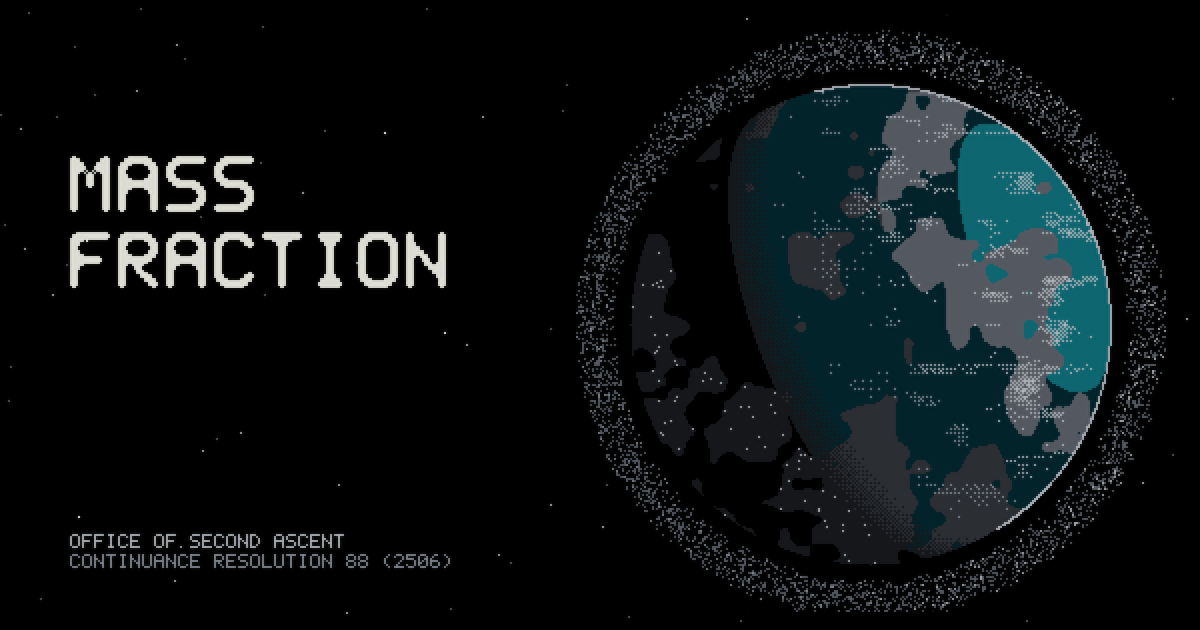
Yesterday I put a game on itch.io, and it is not part of the Heliobane trilogy. That one was a shmup and its sequels. This one is slower, colder, and much more interested in spreadsheets.
Mass Fraction is a hard science fiction space-industry strategy game. You run a small, underfunded space program, and your job is to get mass off the Earth, then people, then an economy that no longer needs the ground. It is drawn at 640×512 in sixteen colours, it plays with a mouse, and it is, openly and on purpose, a love letter to two Amiga games: Deuteros and Millennium 2.2.
Here is the trailer. The game filmed it itself, which I will come back to.
The two games it owes
Millennium 2.2 (Electric Dreams, 1989) opened with a twenty-trillion-ton asteroid making the Earth uninhabitable. You ran the surviving Moonbase: research, mining, solar power, traffic between worlds, and a slow crawl back to a planet you could live on again, while mutant Martians argued the point.
Deuteros: The Next Millennium (Activision, 1991) picked up about eight centuries later. The Earth was habitable again, but humanity had forgotten how to get off it. You started with a headquarters full of rooms and a population pool, trained people as producers, researchers and marines, and rebuilt a space industry one shuttle, one station and one mining run at a time. Both were designed by Ian Bird.
What stuck with me was not the plot. It was the shape of the thing. A room for everything. Research unlocks production, production fills a shuttle, the shuttle builds a station, the station mines a moon, and at some point you look up and realise the whole solar system is a logistics problem you created. Nobody makes these any more. So I did.
The design document puts the lineage in one line: spirit only, no shared names, art, text or music. Everything in Mass Fraction is new. The debt is in the shape.
The Lid
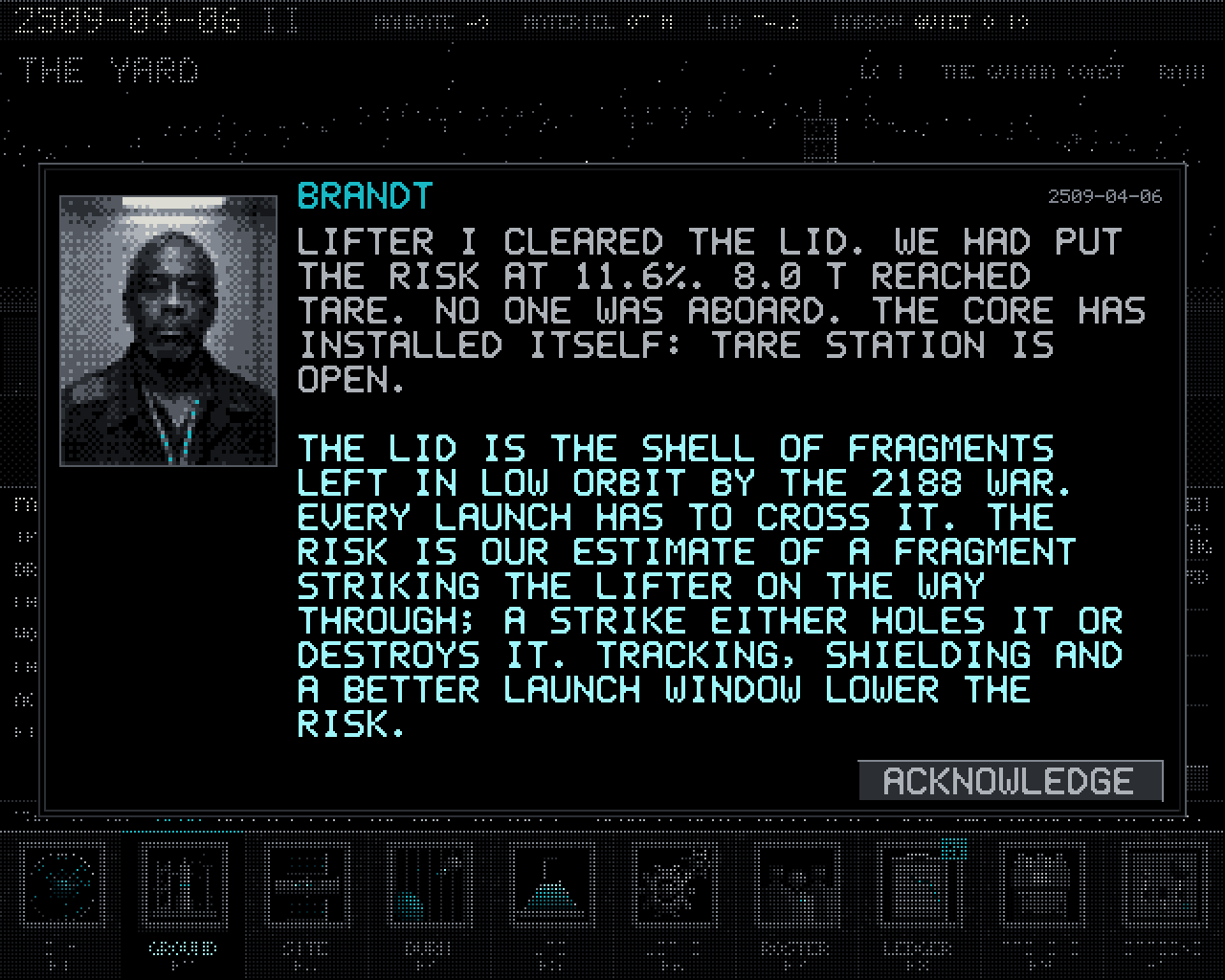
In 2188 a nine-day war in low orbit ground the satellites the world ran on into a shell of fragments. The fragments are still there. They are called the Lid, and for three hundred and twenty-one years everything launched through them has been cut apart on the way up.
Earth didn’t end. It contracted. It is poorer, quieter and smaller, and its remaining governments share one body, the Continuance, whose main work is managing decline without letting it turn into collapse. In 2506 the Continuance funded a small program to try again. You are the Director of the Office of Second Ascent: one launch pad on the Guiana coast, a few dozen staff, and a budget that depends on results. (Second Ascent, incidentally, is about as close to “Deuteros” as I could get in English.)
Above the Lid wait the Harrow. More on them below.
Deuteros, translated
If you played Deuteros, you already know how to play this. The mapping is almost one to one:
| Deuteros | Mass Fraction |
|---|---|
| A headquarters full of rooms | The Yard: launch complex, Works, Laboratory, Academy, Tracking |
| Training personnel | The Academy: named people, months of training, a radiation dose ledger each |
| Research, then production | Laboratory, then Works on Earth, then foundries and yards in space |
| Shuttles to orbit | Lifters through the Lid, with a loss risk on every crossing |
| Orbital industrial centres | Stations and surface bases, assembled module by module |
| Mining moons, shipping ore | Drills, refineries, tugs and barges. Propellant is the currency. |
| The Methanoids | The Harrow: human-made, indifferent, procedural |
| Out to the stars | The Registry. No faster-than-light anything. |
Real time with pause and three speeds, one tick is one day. F1 to F10 jump between the ten rooms, but everything works with the mouse, as it should.
What you actually do
You start on the ground, in the rain.
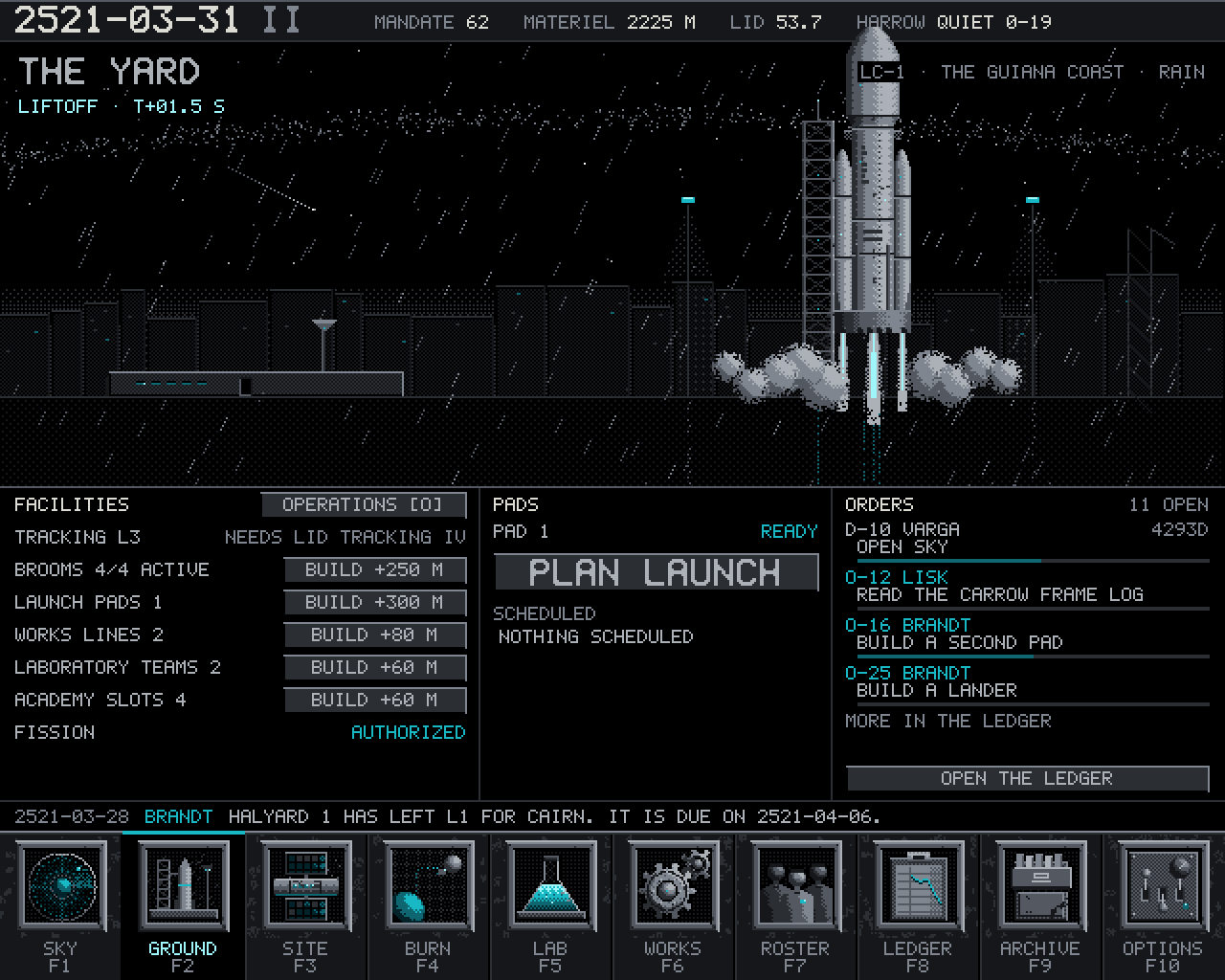
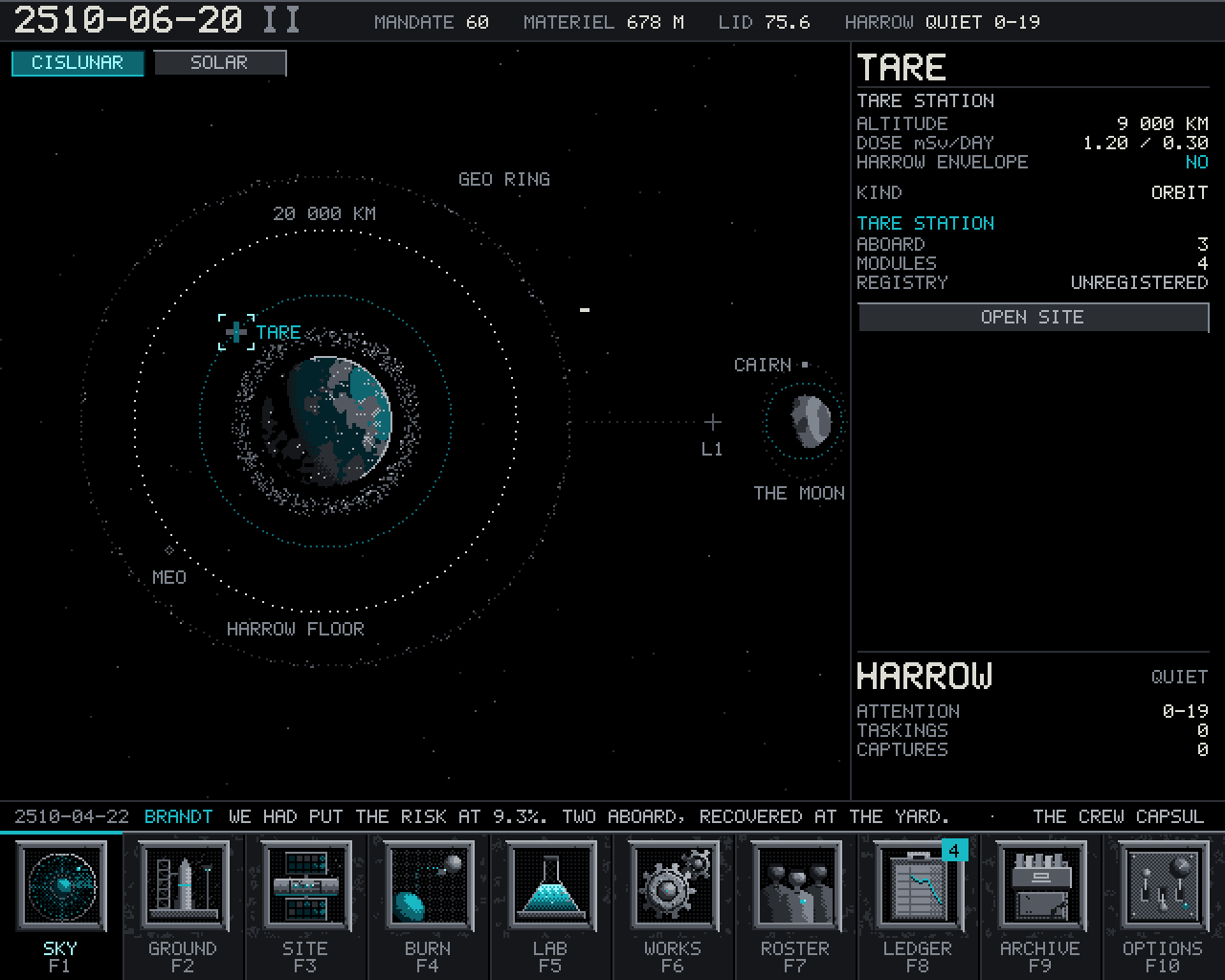
Every launch has to cross the Lid, and every crossing has a number on it: the chance a fragment hits your Lifter on the way through. Tracking, shielding and a better launch window push it down. They never push it to zero.
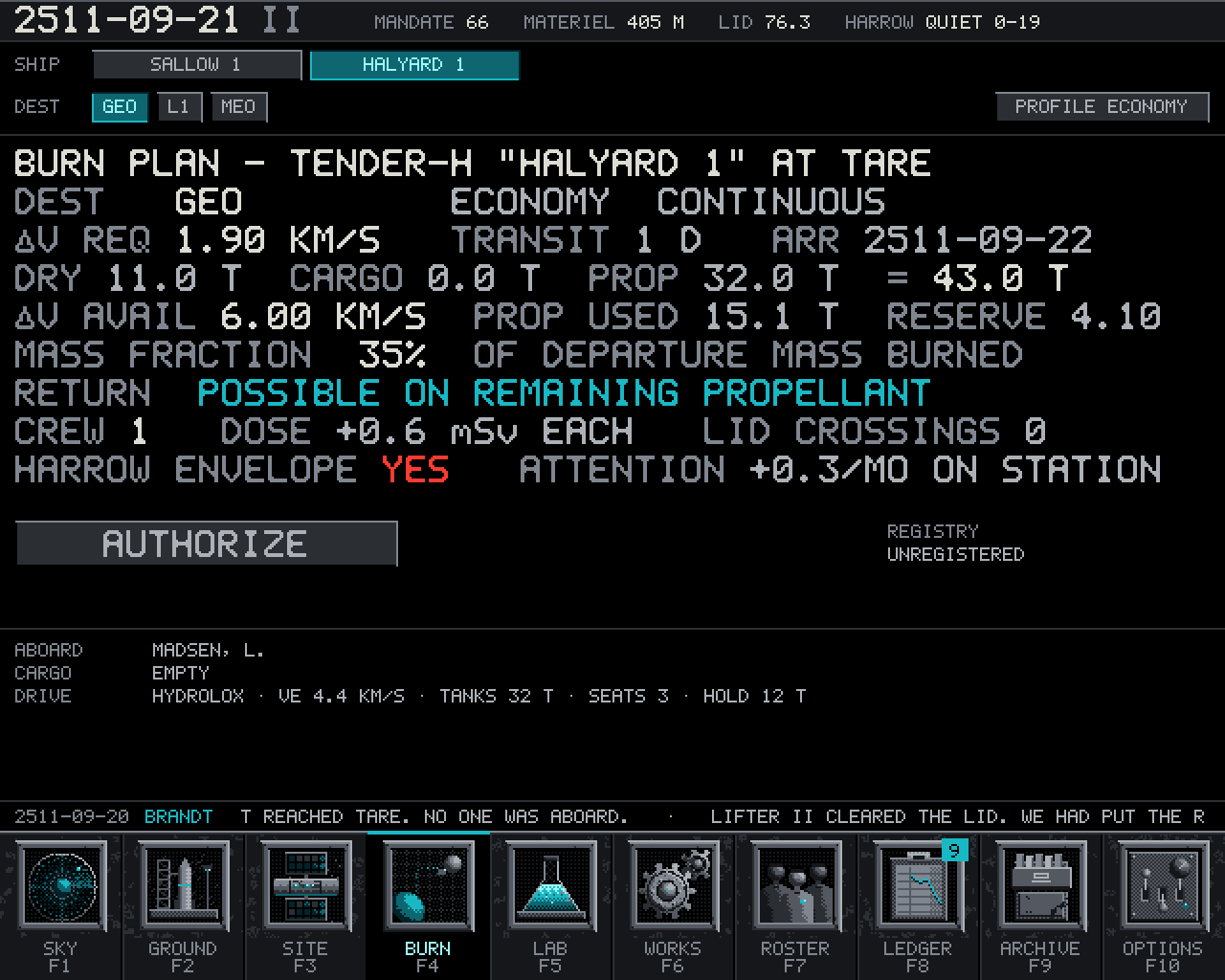
The title isn’t decoration. The mass fraction is the share of a ship’s departure mass that is propellant it will burn, and the Tsiolkovsky rocket equation is the main interface of the game, not a hidden stat. Every burn plan shows you the arithmetic: delta-v required, delta-v available, propellant used, and what is left for the trip home.
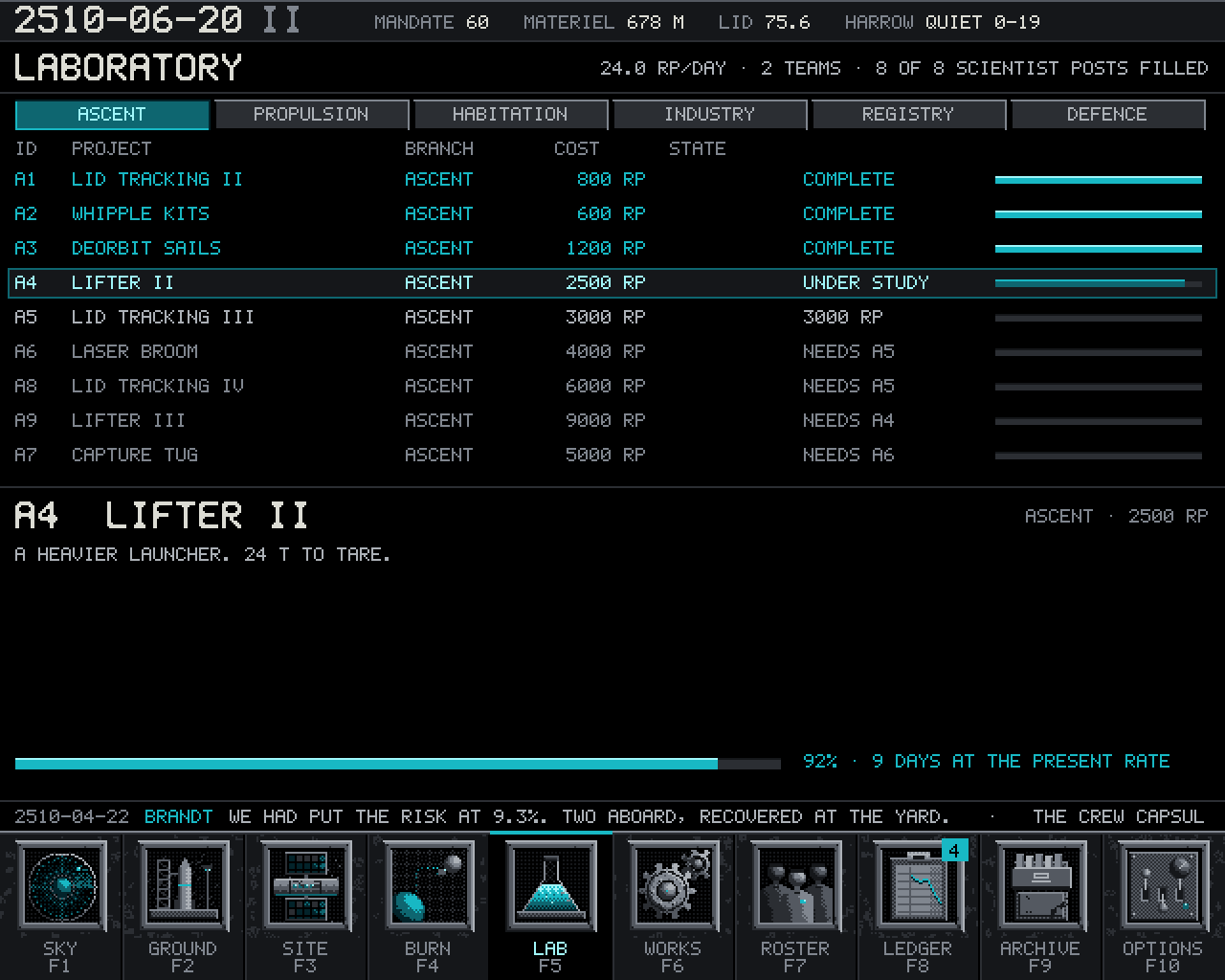
The Laboratory turns years into technology, and the Works turns technology into modules you then have to lift. Nothing is free, and nothing arrives assembled.
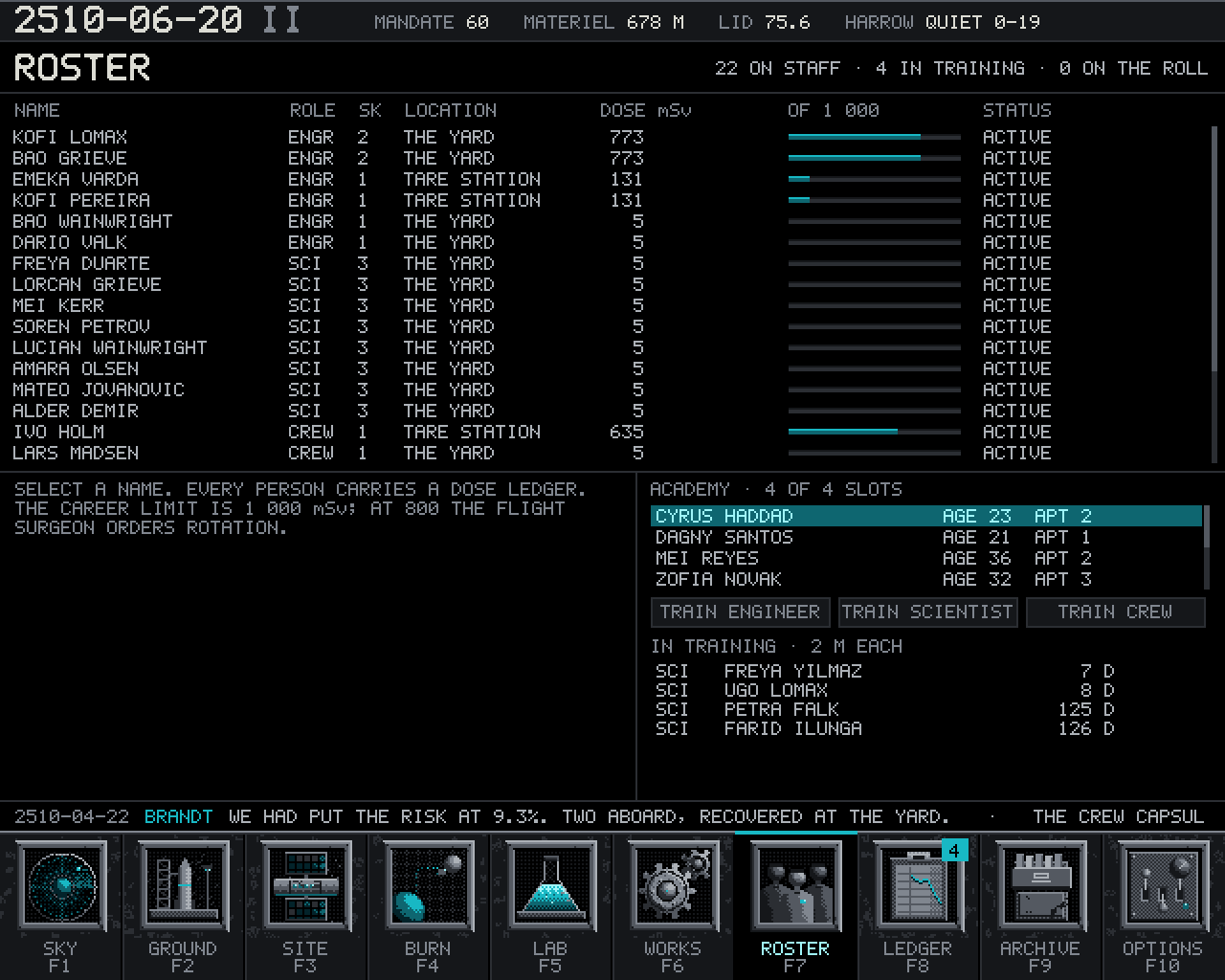
People are the scarcest resource. Everyone has a name, months of training and a dose ledger. There is a career limit of 1,000 mSv, and at 800 the flight surgeon rotates you home. Nobody respawns. The dead are listed on the Roll, and the Roll does not get shorter.
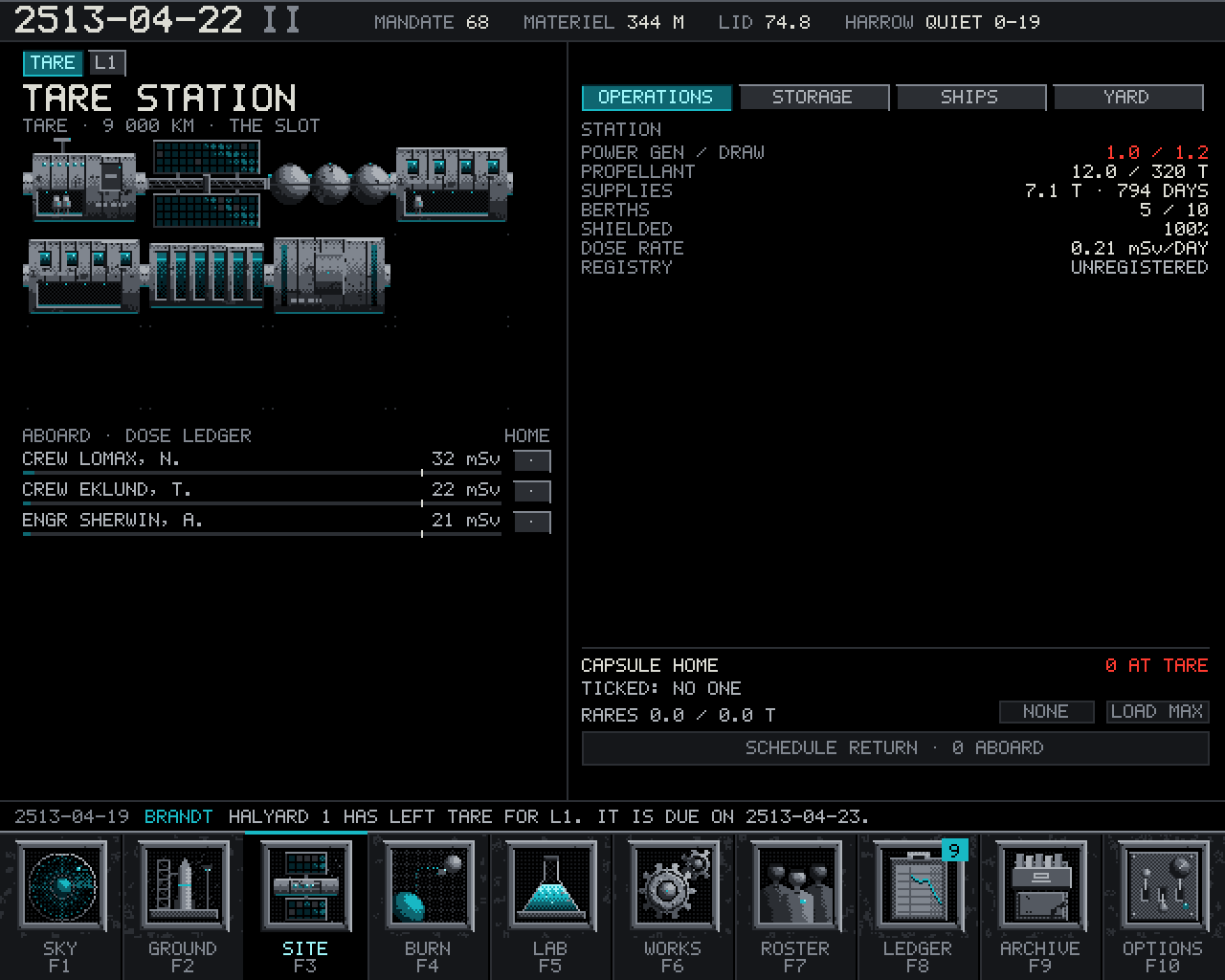
The first station is Tare, parked at 9,000 km in the slot between the radiation belts. Then a depot at L1, ice on the Moon, propellant made where you need it rather than lifted through the Lid, and on out to Mars and the Belt. The Moon is the Millennium 2.2 half of the love letter.
The Harrow
Deuteros had the Methanoids, who turned out to be colonists from the first game who had declared independence. Mass Fraction has no aliens, but the opposition is human-made too, in a way.
In 2161 the old Compact launched the Harrow: self-replicating industrial machines, sent to prepare the solar system for settlers. The settlers never came. The Harrow kept working. They have built habitats nobody lives in and kept the air in them at 21 °C for three centuries. And they remove anything that is not in their registry.
The registry was last updated on 18 March 2188. Everything you build above 20,000 km is, as far as the Harrow are concerned, debris.
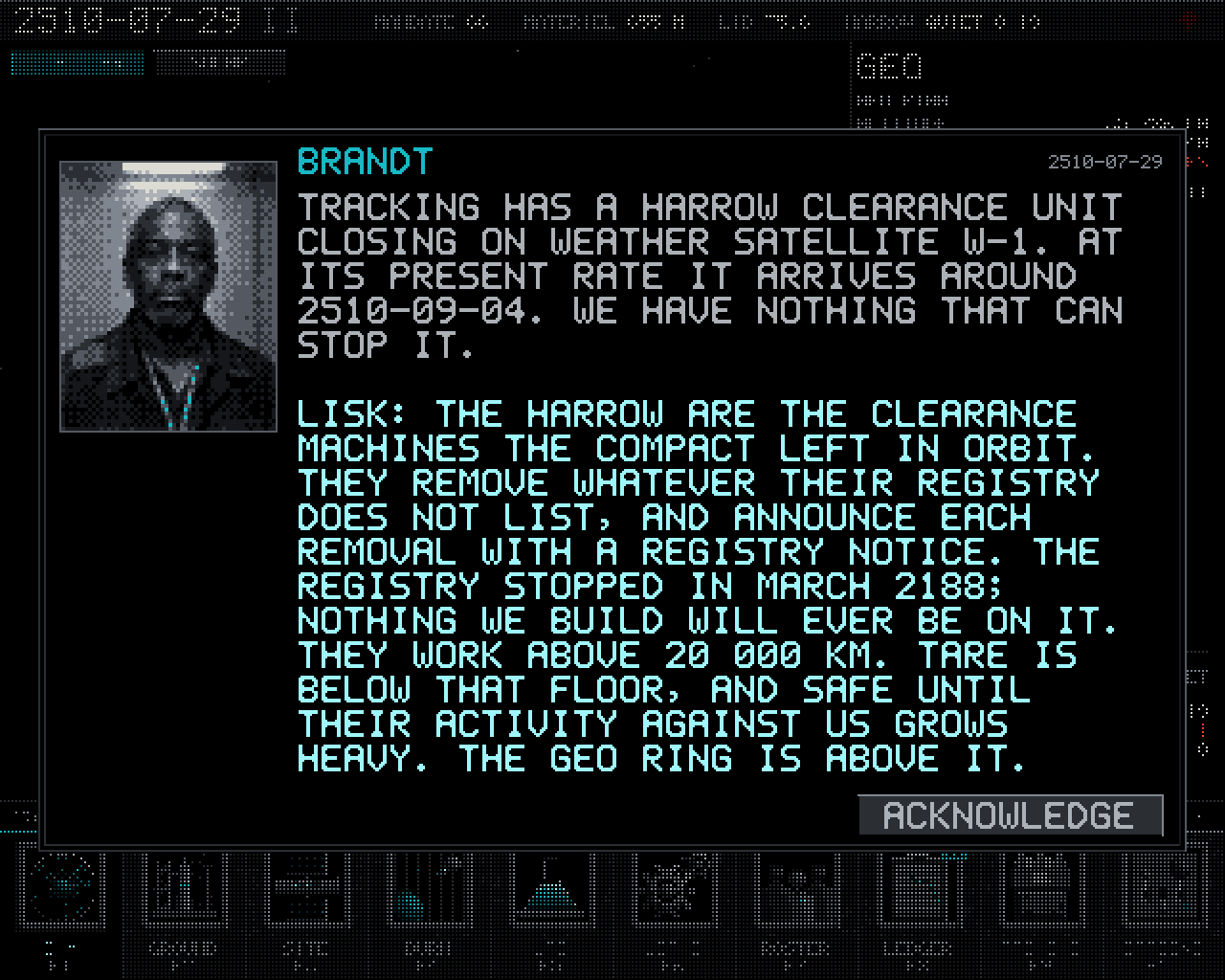
They don’t hate you, and you can’t negotiate with them. They follow a charter. Their behaviour is procedural and readable, so you can stay under their floor, keep your activity quiet, and avoid them, at a price. Or you can go looking for pieces of the registry’s root key and find out whether a machine that follows orders can be given new ones.
The campaign runs in four acts, The Lid, The Gap, The Dead and The Harrowed, and ends with the Broadcast, which has two endings. After that, Continuance Mode lets you keep going. You lose if the Continuance loses confidence in you, if Earth’s capacity runs out, or if you are left with no working pad and nobody above the Lid for 180 days.
Sixteen colours
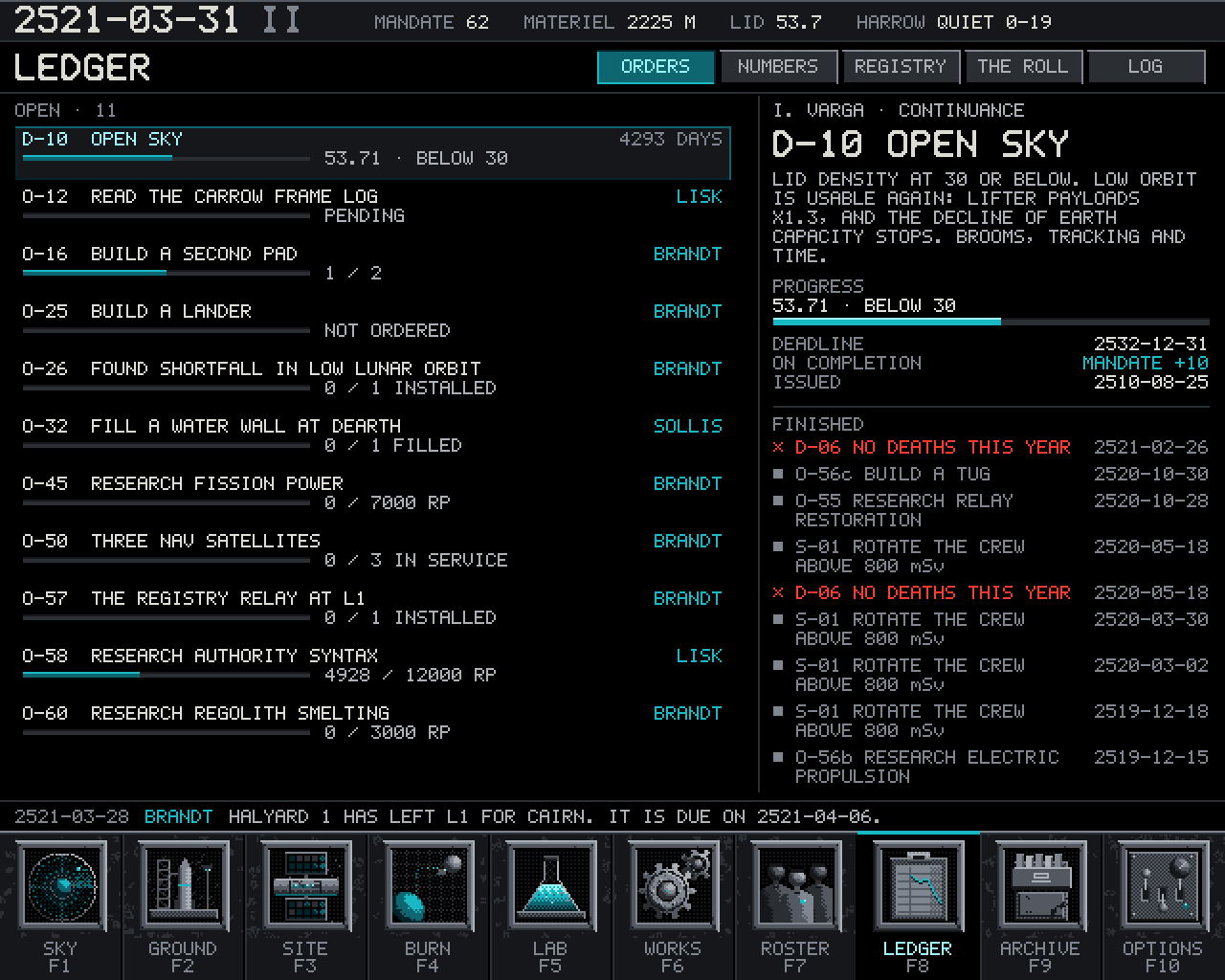
The look is Amiga PAL hi-res: 640×512, interlaced, in sixteen colours. The number isn’t a mood choice. On the original chipset, hi-res gets you four bitplanes, and four bitplanes is sixteen colours. HELIOBANE got thirty-two because it lives in low-res. If you have read my love letter to what people still wring out of 1985 silicon, you know I consider these limits a feature.
The palette has a law, and it fits in three sentences. White is theirs. Harrow hulls, registry text, everything from before the war. Cyan is ours. The Office’s ships, stations and trajectories, and Earth’s oceans. Red is what it costs. Alarms, losses, radiation and the Roll. Red never decorates. Everything else is grey, because everything else is the world.
Gradients are 4×4 ordered Bayer dither, and nothing else. The four department heads are digitised portraits in greys plus one accent colour. One of them, Lisk, who runs the Laboratory and reads the Harrow’s notices as law, has my face. I asked. It seemed only fair.
There is no music in space. You get room tone: the rain on the Yard, the hum of a station, telemetry. Music plays on the title, on GROUND, on the act cards, and when the Harrow move against the Office. You will learn to dread that last one.
How it got made
The design document is dated 26 September. Both itch pages went public on the 28th. It is built in Godot 4, and under the screens is a pure simulation that runs headless. The test gate has a scripted Director play 24 seeded campaigns to the year 2545, and every milestone has to hold in enough of them. It is the least retro part of the game, and the part I’m proudest of.
Claude wrote the code and Codex reviewed it, read-only, over tincan. Some changes needed five rounds of rechecks before Codex would pass them, and one balance fix was rejected outright. I directed, played, and complained that the notices sounded omniscient, which is why every notice in 0.9.1 is now signed by a person who could actually know what it says.
And the trailer: the game films it itself. A script drives the game through Act I, Godot’s Movie Maker records it at 50 fps, teleprinter cards cut in between, and the score is cut to the beats from two of the game’s own pieces. When the game changes, I re-shoot the trailer with one command.
A small aside for the Amiga crowd: a port to a real A1200 is on the bench, written in C against the bare hardware, at 640×256 to spare your eyes the interlace flicker. The first screens match the PC version pixel for pixel in a cycle-exact emulator. No promises yet. But it would be rude not to try.
Play it
- Mass Fraction on itch.io: $6, for Windows, macOS (signed and notarised) and Linux.
- The free web demo: Act I in your browser, up to the start of Act II or the end of 2512.
It is version 0.9.1, a playtest build. The whole campaign plays from the title screen to both endings, and it still has rough edges. If you play it, keep short notes with the in-game date, for where you got stuck, text that confused you, and whenever the Harrow felt unfair. I want all of it.
If this looks like your kind of game, G-COPY is another Amiga homage, free in your browser, and the rest of the shelf lives at gand.games. The State of Gand post explains why the games moved out of the tools’ house.
The Lid has been up there for three hundred and twenty-one years. Somebody has to go first.
related entriesshared tags